Now in millimeters.
Phase 01 set the ritual inside the room. Phase 02 placed the building in the world. Phase 03 makes everything constructable — each decision now arrives as a measurement.
A 10m cube, measured.
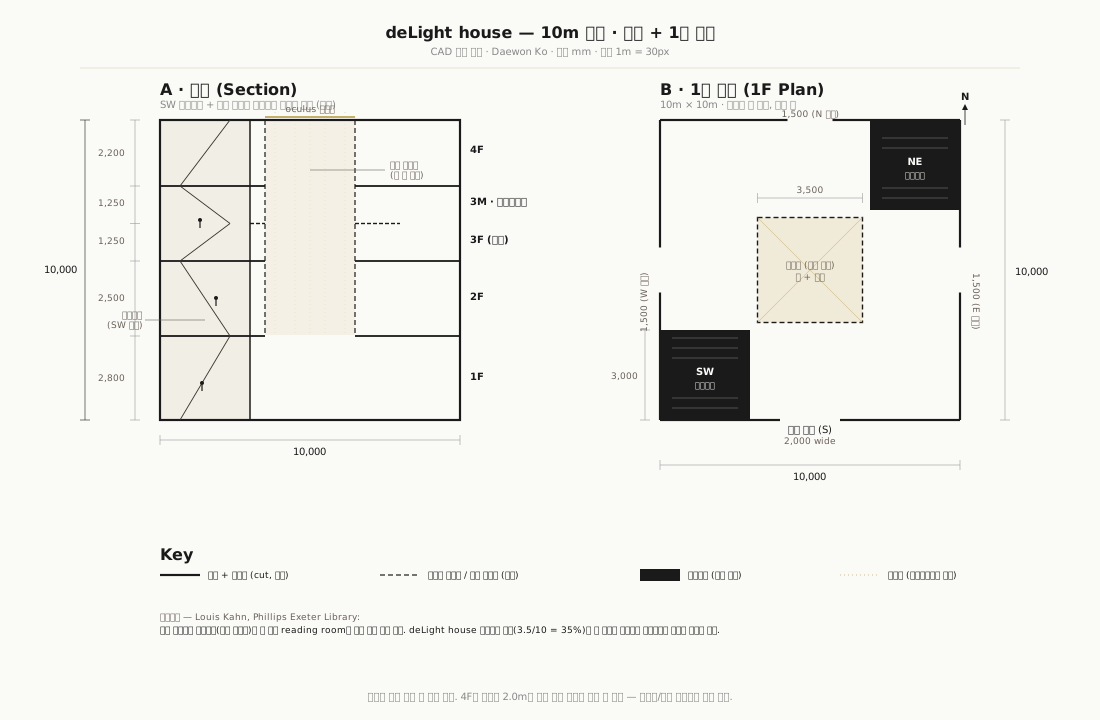
The dimensions that follow are not new decisions — they are the prior phases counted in millimeters. The 10m cube becomes four main floors plus a skip-floor mezzanine; the two diagonal walking towers settle at 3m × 3m; the central void widens to 3.5m × 3.5m, a Kahn-influenced ratio.
The drawing below is the CAD-ready reference: section through one walking tower and the central void on the left; 1F plan on the right. Both are dimensioned in mm with origin at the SW corner.
Dimension, made of mass.
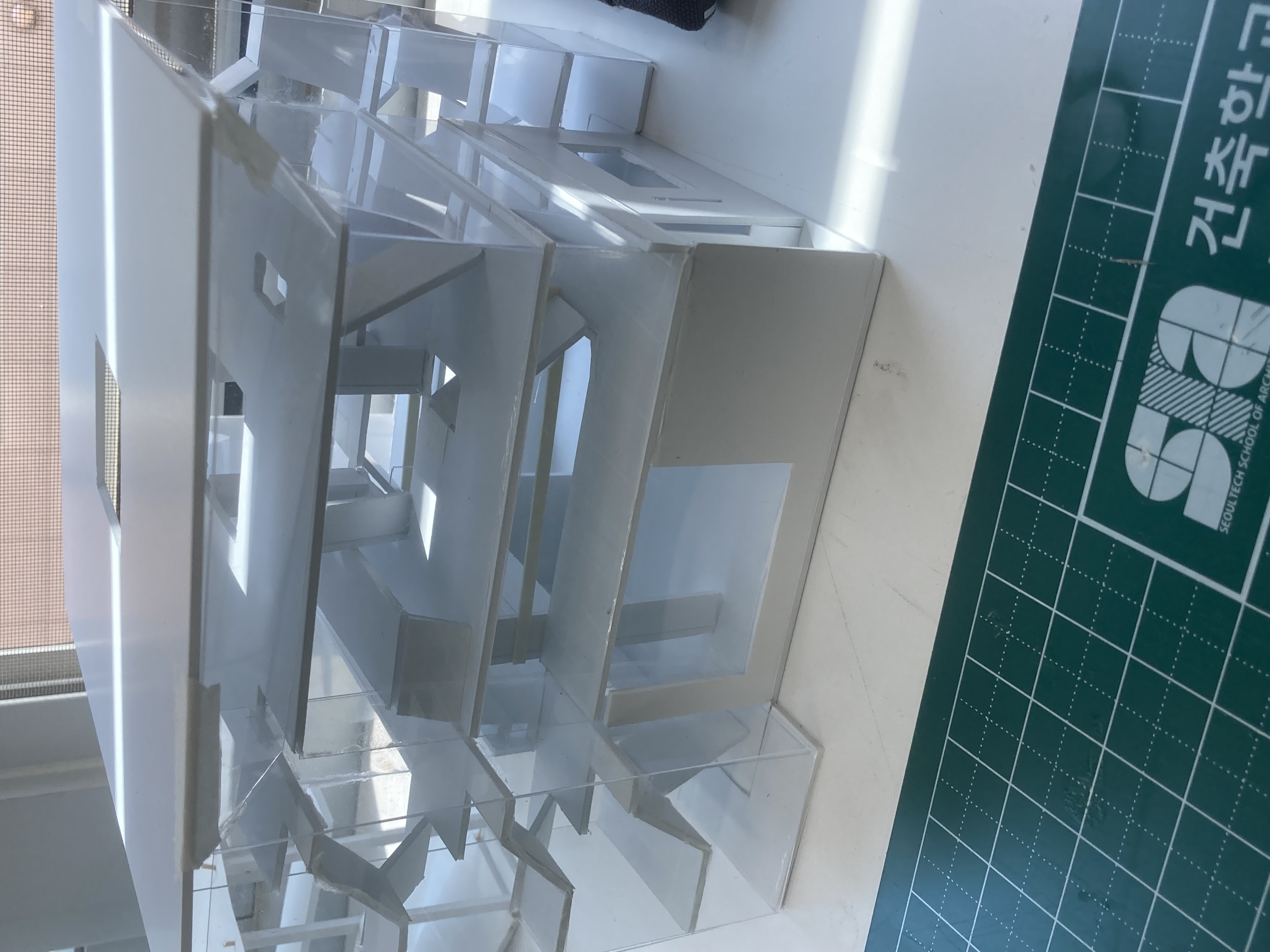
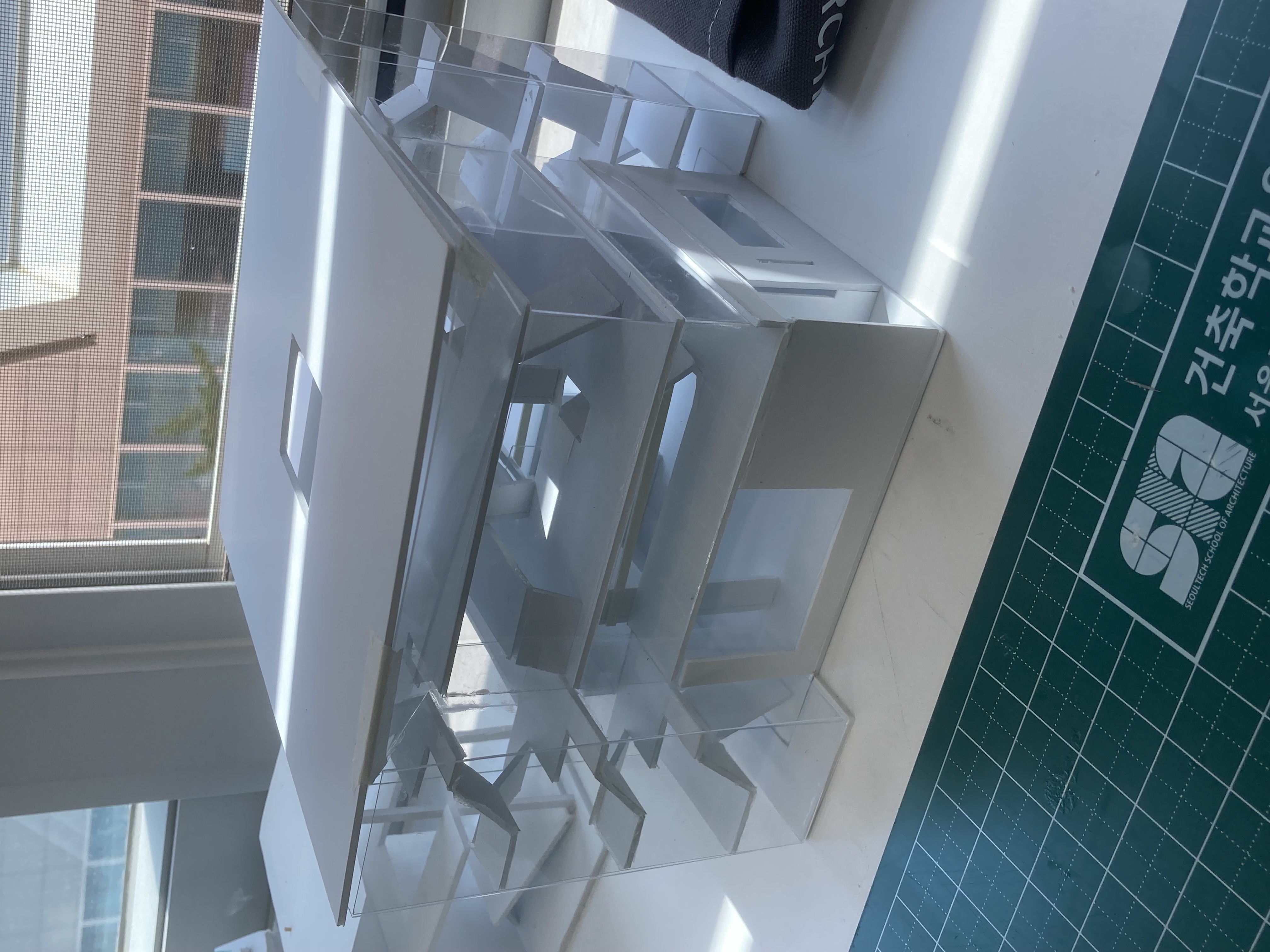
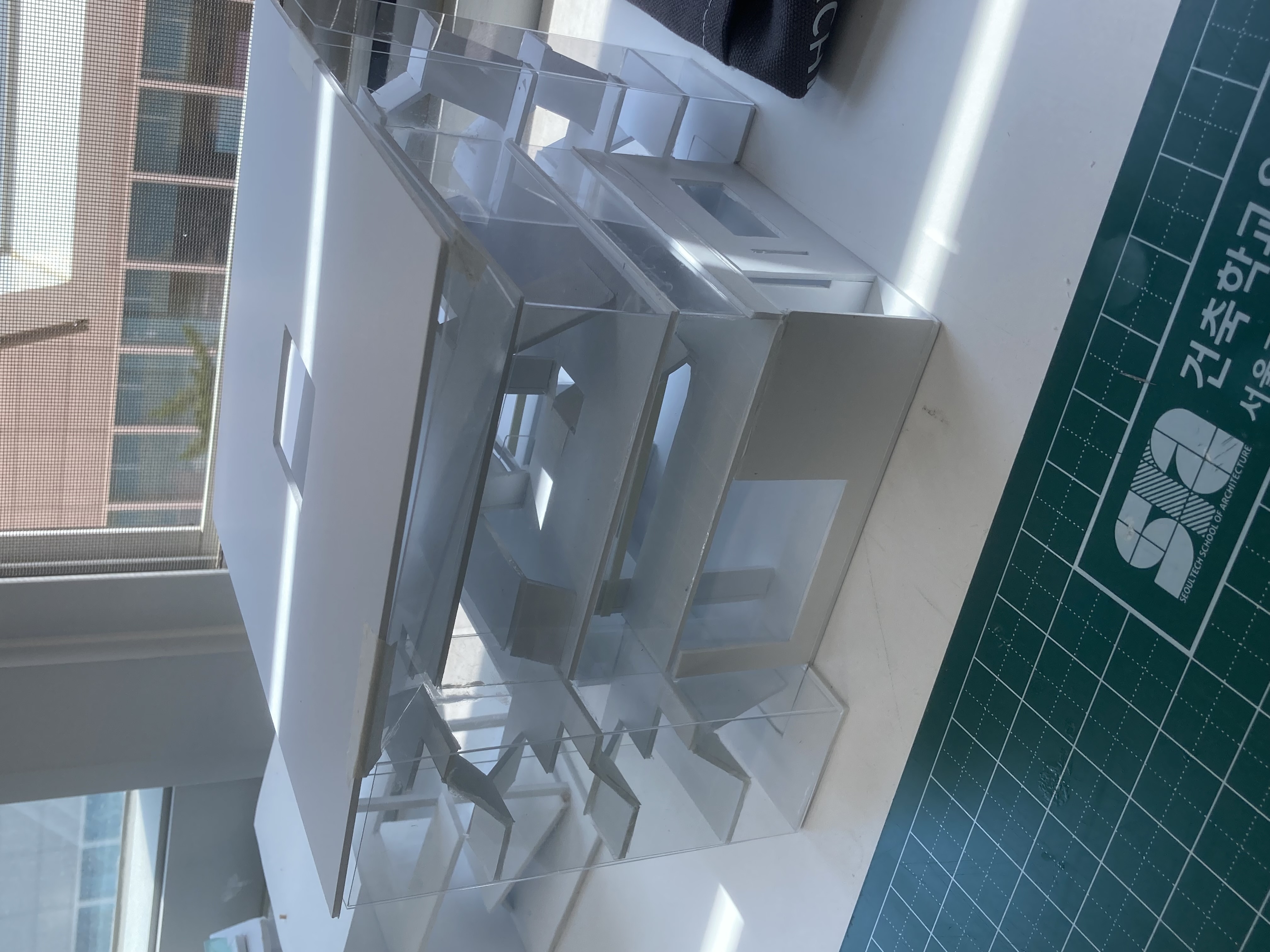
The model translates the drawing one more step — from CAD to acrylic and paper. The clear envelope lets the void read straight through; the slabs stagger across heights; the diagonal corner walking towers extend the full 10m with their internal switch-back stairs visible from outside. The oculus is cut at the top center, square, exactly where the void shaft begins.
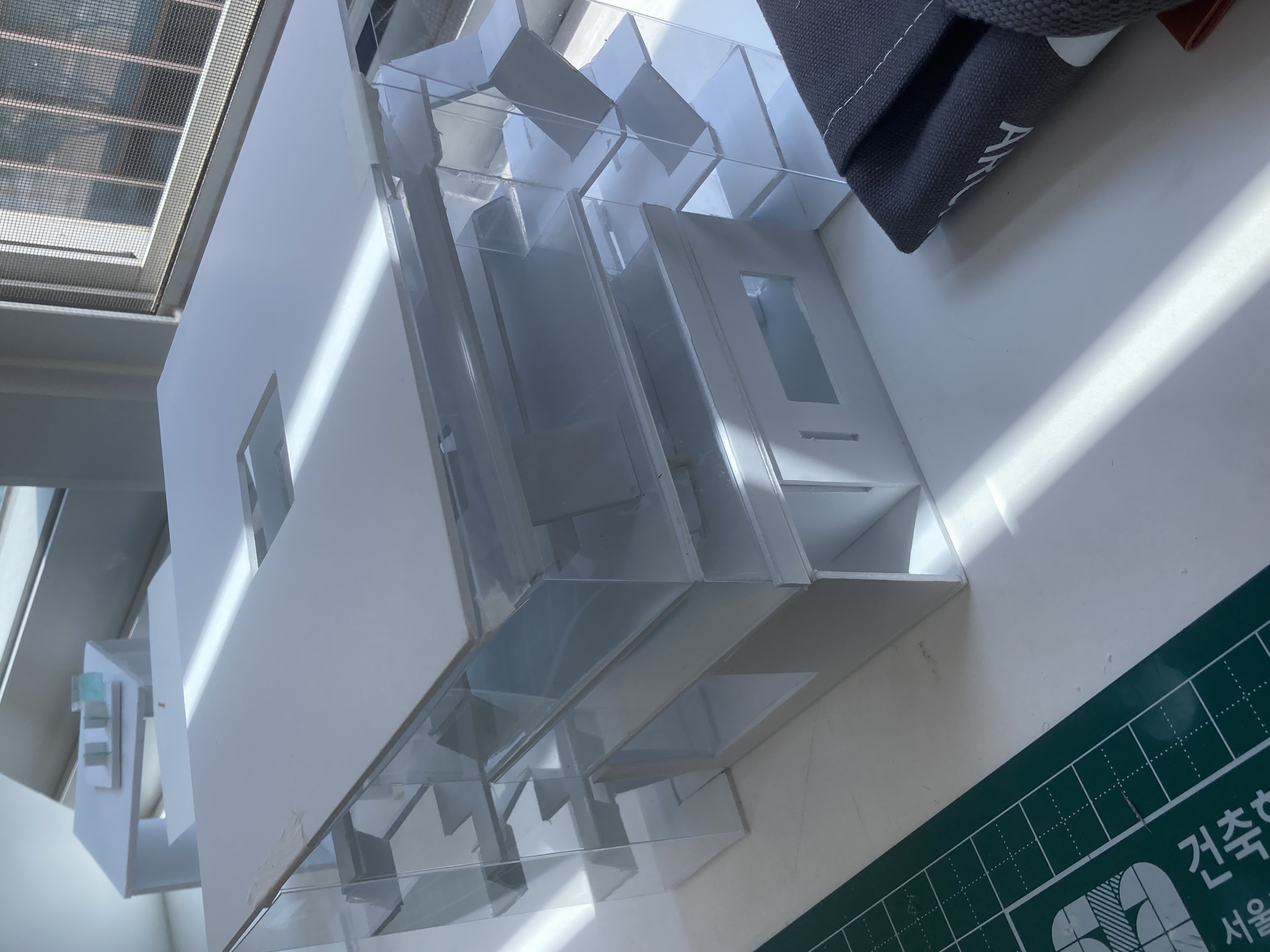
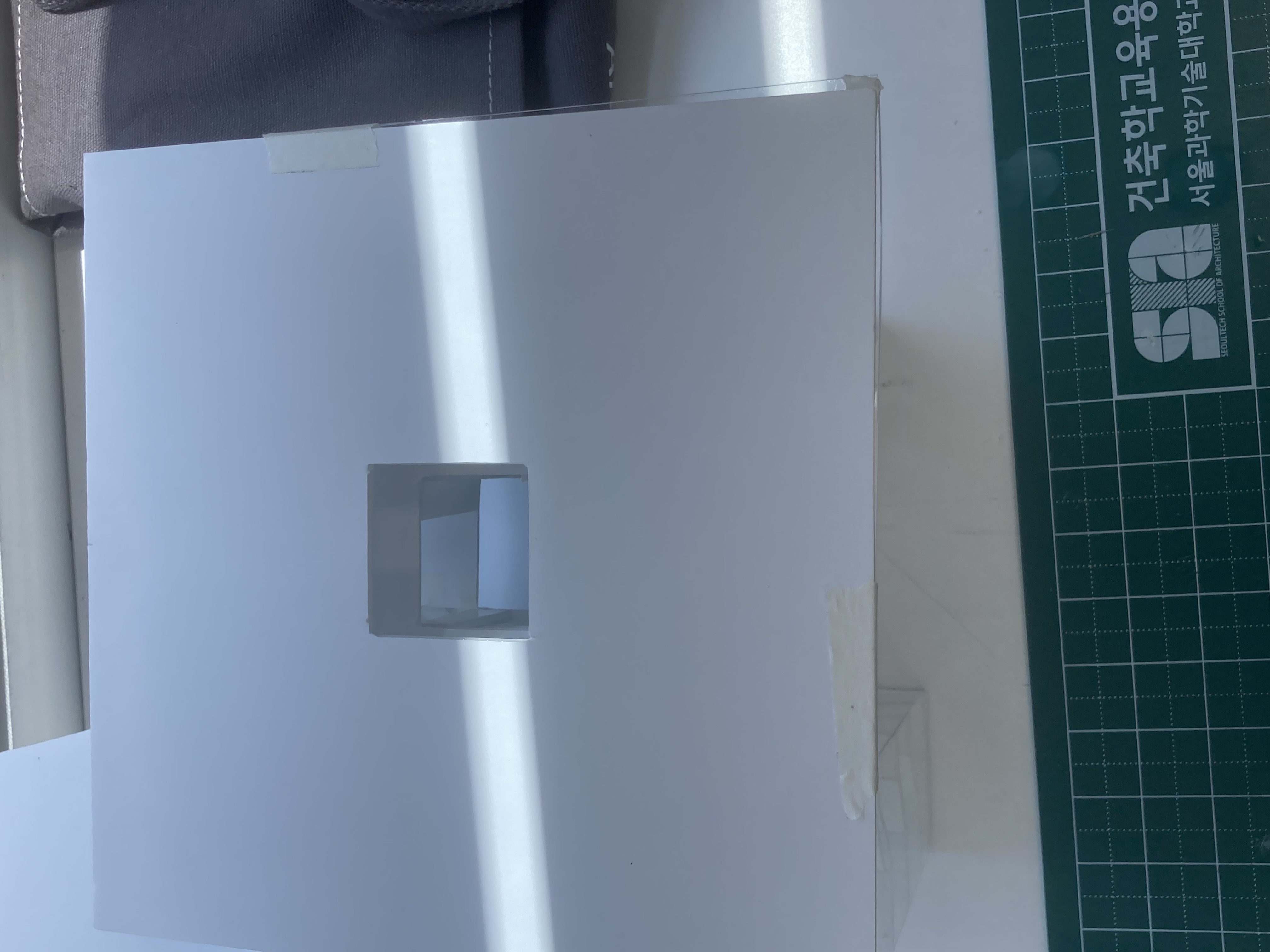
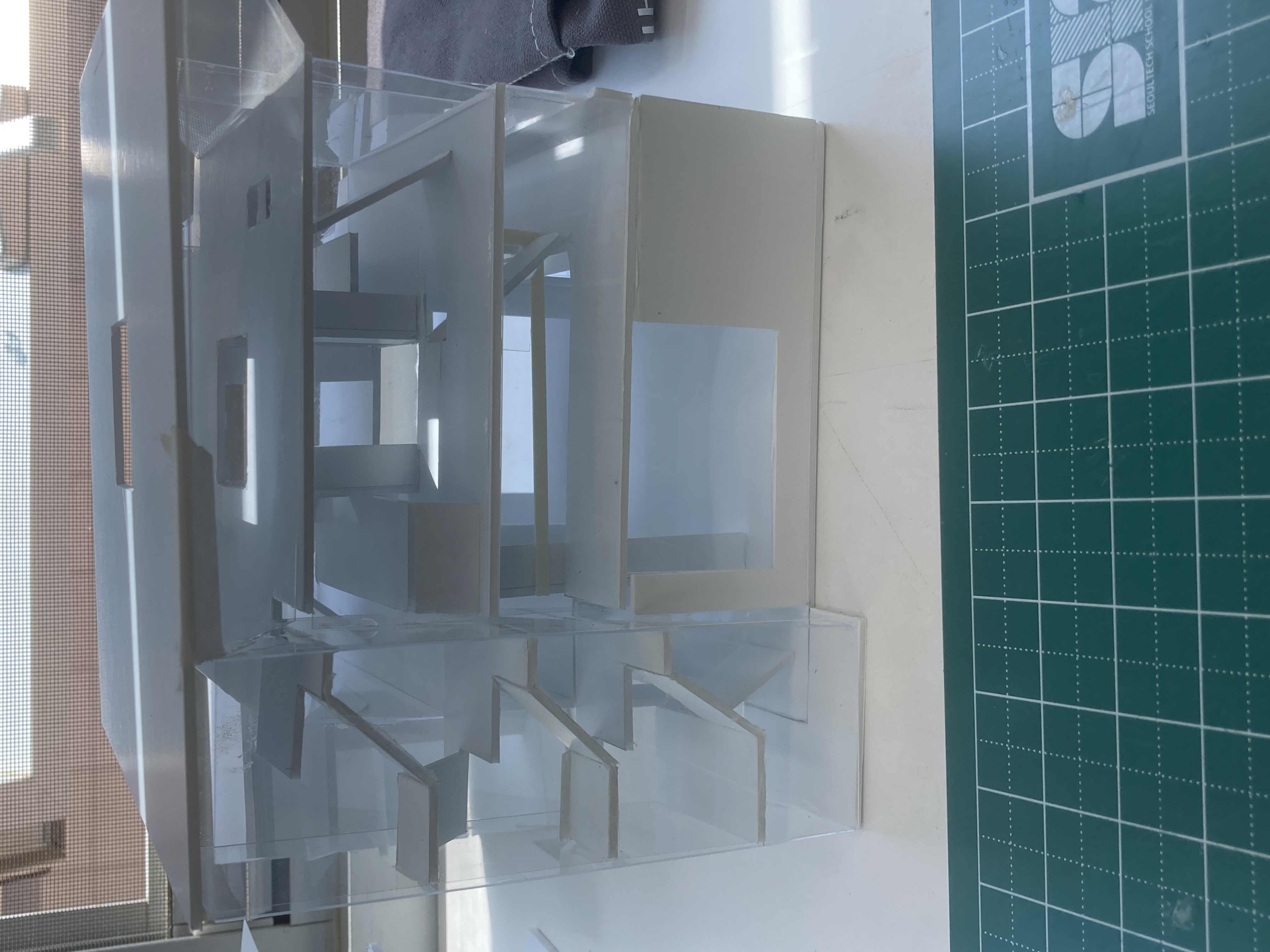
Four floors plus a skip — 10,000 mm total.
The cube divides asymmetrically: the entry is generous so the audience can settle without compression; the audience levels above are compact; the top floor is a balcony ring around the oculus. The 3F skip-floor (3M) is a partial mezzanine for downward viewing — non-habitable by code, but functional as Kahn-style observation perch.
Two corners. One void. Four ways in.
The two walking towers occupy the SW and NE corners — diagonal, always the same pair. Each is 3,000 × 3,000mm, sized for a U-shape switch-back stair (1,200mm tread, 175mm riser) that travels the full 10m.
The central void measures 3,500 × 3,500mm, centered at (5000, 5000). It opens at every floor and extends from 1F ceiling to the rooftop oculus. 1F entries are distributed across all four sides — the main southern entry is 2,000mm wide (the Tiffany approach lands here), N · E · W slits are 1,500mm each. Upper floors close the perimeter to a continuous frame; only the corner towers and slit windows break it.
Phillips Exeter Library — the void ratio.
Kahn’s Exeter Library held a 14m central atrium inside a 33m square (~42% of the plate). deLight house lands at 3.5/10 = 35% — slightly more restrained, but the Kahn move is present: every floor opens onto the void, every floor offers a downward viewing axis, and the light from the oculus reaches the ground floor directly. The Phase 02 spatial reading (multi-height audience, diagonal sightlines) becomes a literal vertical organization here.
Every measurement points back to a prior decision.
What Phase 04 will settle.
A few moves remain unmeasured: the walking-tower envelope (clear glass vs. metal mesh; 3m switch-back vs. 2.5m spiral); the cube’s outer skin material (glass type, mullion module); the variation rules across the five-city network (what stays identical, what answers the city); the lighting schedule (oculus diurnal/seasonal behavior). Phase 04 takes these on.
Dimension is just narrative made measurable.